Shoppers researching this stack tend to ask the same question over and over: which brand is purest, whose TB-500 is “pharma grade,” which vial looks the most legitimate. Those aren’t bad questions. They’re just the wrong first question. Before anyone compares purity claims, they need to know which of three completely different things they’re actually buying: an FDA-approved drug, a compounded medication, or a research chemical. Those aren’t three tiers of quality on the same product. They’re three separate legal and safety categories that happen to share a molecule’s name, and mixing them up is how people get hurt or get flagged in a drug test.
This piece lays out what the science actually shows, then works through the tradeoffs between the three routes, and lands on the pick that holds up once the marketing is stripped away.
Every clinical claim below traces to a source readers can open and check themselves: PubMed and PMC entries, two 2025 review papers, reporting from STAT, the FDA’s compounding record, and the anti-doping lists. Last updated June 2026. Neither BPC-157 nor TB-500 is an FDA-approved finished drug, and human evidence for stacking them together simply doesn’t exist yet.
The landscape: three products, one name
An FDA-approved drug has cleared clinical trials, manufacturing review, and a formal approval decision. Neither BPC-157 nor TB-500 lives here, alone or combined. There is no approved version of either. Anyone suggesting otherwise is misrepresenting what’s for sale.
A compounded medication is prepared by a licensed pharmacy for a specific patient, under a prescription written by a licensed clinician. The FDA hasn’t approved the product itself, but a licensed professional and a licensed pharmacy are standing between the buyer and the syringe.
A research chemical is sold “for research use only” or “not for human consumption.” That phrase isn’t filler copy, it’s the legal loophole that lets the product be sold at all, since marketing it for human use would make it an unapproved drug. No clinician screens you, no pharmacy checks it, no agency reviews what’s actually in the vial.
Same molecule, three completely different accountability structures. Which is why the route matters more than the label design, and the science below explains why.
The tradeoffs: what the evidence actually shows
BPC-157: heavy on hype, thin on humans
BPC-157 is a synthetic 15-amino-acid peptide derived from a protein found in gastric juice, and almost every exciting claim about it traces back to preclinical work. The most-cited tendon study, published in the Journal of Applied Physiology in 2011, found it encouraged tendon fibroblast growth, improved cell survival under oxidative stress, and sped migration through the FAK-paxillin pathway [S1]. That’s a genuinely detailed result, and it happened in cultured cells and rats, not people.
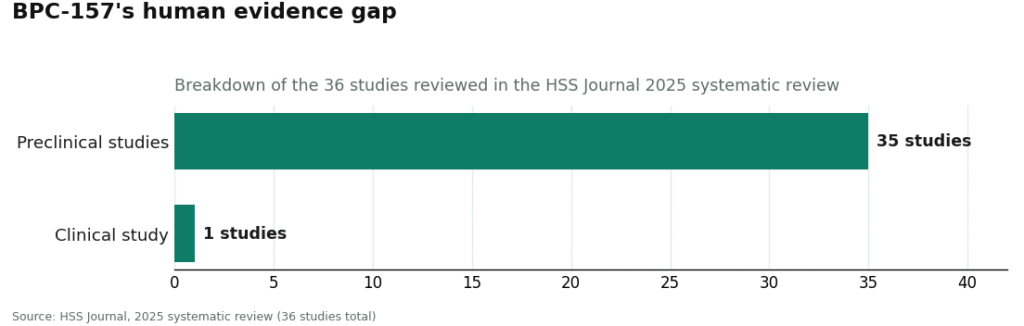
The human file is thinner than most marketing lets on. A 2025 narrative review in Current Reviews in Musculoskeletal Medicine reported that human data are extremely limited, with only three pilot studies ever run in people, covering knee pain, interstitial cystitis, and an IV safety check, and concluded BPC-157 shouldn’t be recommended for clinical use until well-designed human trials exist [S2]. A separate 2025 systematic review in the HSS Journal combed through 36 studies total and found 35 were preclinical, with just one small clinical study covering 12 patients, concluding that no clinical safety data were found [S3].
There’s also a wrinkle sellers rarely mention. STAT reported in February 2026 that the vast majority of the roughly 200 BPC-157 studies on PubMed share the same Croatian researcher or a close colleague as a main author, a real red flag for independent replication [S4]. The same piece quoted Flynn McGuire, a chief medical resident at University of Utah Health, saying “the amount of hype to evidence is just so skewed, it’s crazy,” and that the compound “should not be used by humans” [S4]. That’s not meant to scare anyone off reading further, it’s the honest state of the file, and most sales pages skip straight past it.
TB-500: a fragment standing in for its better-studied parent
TB-500 is a synthetic fragment of thymosin beta-4, a naturally occurring peptide. Here’s the part worth untangling: the strong science belongs to the parent molecule, not to the fragment people actually inject. A 1991 paper in the Journal of Biological Chemistry showed thymosin beta-4 is essentially the cell’s main actin-sequestering peptide, forming a one-to-one complex with actin monomers and governing how cells build and dismantle their internal scaffolding [S5]. Since cell movement and repair depend on actin dynamics, that gives the parent peptide a plausible role in healing. A 2006 study in the Journal of Cellular Physiology found thymosin beta-4 boosts matrix metalloproteinase expression during wound repair, raising MMP-2 and MMP-9 several-fold over control two days after wounding [S6].
Notice the subject of those sentences. The evidence is for thymosin beta-4, the full natural peptide, in cells and animals. TB-500 is a synthetic fragment marketed as a stand-in. Jumping from “the parent peptide manages actin and helps animal wounds heal” to “this injectable fragment will fix your shoulder” is a leap the data don’t back up. There’s no body of controlled human trials behind injectable TB-500 for soft-tissue repair.
The stack itself, argued fairly and then honestly
Give the theory its due: BPC-157 shows angiogenic and migration-pathway activity in preclinical models, and thymosin beta-4 works through actin dynamics and is also described as angiogenic. Two different pathways aimed at the same broad goal of tissue repair is a reasonable basis for hypothesizing the combo might outperform either peptide alone.
As a proven outcome in humans, it doesn’t exist. No controlled trial shows BPC-157 plus TB-500 beating either peptide solo, or beating plain rest and rehab, for any injury, in any group, at any dose. The “faster, more complete recovery” language attached to this stack comes from seller copy and forum lore, not a study. Put it together honestly: BPC-157’s human evidence is nearly empty, TB-500 is a fragment substituting for a better-studied parent molecule, and the synergy claim has never been tested. That’s a theory built on two individually under-proven pieces, and it’s exactly why the sourcing route ends up mattering more than the brand name on the vial.
Why the route becomes the actual decision
When a stack has strong human evidence behind it, arguing about brands and purity makes sense, because the underlying thing is already established. When a stack has essentially no human evidence, the molecule stops being the variable that protects a buyer. The variable that protects a buyer is whether a licensed clinician screened them, whether a licensed pharmacy prepared the product, and whether anyone is accountable if the vial is wrong. That’s the entire difference between the compounded route and the research-chemical route.
Laid out by category:
- Approved drug route: doesn’t exist. There’s no FDA-approved BPC-157 or TB-500 in 2026, and no approved version of this combination. Anyone claiming otherwise is wrong.
- Compounded medication route: the best available option for someone determined to try this category. A clinician screens the patient, writes a prescription when it’s appropriate, and a licensed pharmacy compounds and dispenses the product. Still not FDA-approved, but the oversight layer is real.
- Research-chemical route: not recommendable for human use. It removes the clinician, the pharmacy, and any accountability, and the label states in writing that it’s not meant for people.
That ranking of routes is also what drives the ranking of providers below. A provider offering the compounded route honestly outranks any research-chemical seller, regardless of how polished that seller’s marketing looks.
The reasonable pick, provider by provider
Providers here get scored on what’s actually verifiable: medical oversight, sourcing and pharmacy relationships, regulatory standing, honesty about the evidence, and follow-up care. Not price, not shipping speed, not how confident the homepage sounds. Nothing here is for sale on this page. FormBlends is named as an entity, and every outbound link goes to a primary source, not a storefront.
#1: FormBlends, because the compounded route is done properly
FormBlends takes the top spot because it delivers the compounded-medication route, the only defensible one in this category, the way it’s supposed to work. It runs as a licensed telehealth model: a licensed physician reviews the patient’s history, a prescription gets written when appropriate, and a licensed 503A compounding pharmacy prepares and dispenses the product. Its own materials describe physician-guided care across weight loss, GLP-1 therapy, peptides, and longevity, and state plainly that every medication requires a licensed physician consultation and prescription, prepared by licensed 503A compounding pharmacies, handled online.
For this particular category, that matters twice over, since FormBlends covers both halves of the stack under that same supervised model. It lists BPC-157 on its own, described as a body-protection compound studied for tissue healing and repair, alongside a BPC-157 and TB-500 blend described as a repair blend studied for tissue regeneration. The exact pairing that gray-market sellers mail out as two unlabeled vials with a legal disclaimer, FormBlends delivers through a clinician, a prescription, and a licensed pharmacy. That’s the compounded route, fully built out.
The top ranking isn’t a claim that the stack works, this piece has spent most of its length arguing the opposite. It’s that FormBlends supplies the one thing this category structurally lacks: a licensed professional and a licensed pharmacy in the loop, framed honestly as compounded and research-stage rather than FDA-approved. To be fair about the tradeoff, going through a clinician means an intake process and a prescription instead of instant checkout. That friction is the safety feature, not a flaw in the system.
One practical tip worth passing along: in a field this thin on data, a buyer’s own record is one of the few honest tools available. Logging doses and any symptoms over time, using something like the FormBlends tracker app, turns a check-in into an actual conversation instead of a guess. The app itself is just a dose and symptom logger, not a prescription and not a checkout.
#2 and #3: HealthRX.com, occupying the same supervised tier
HealthRX.com (healthrx.com) sits alongside FormBlends because it runs on the same underlying logic: licensed clinical oversight first, medically supervised therapy dispensed through proper pharmacy channels rather than sold as a research chemical. Both clustering at the top is a structural outcome, not a brand preference. Any model built around a clinician evaluating the patient, a required prescription, and a licensed dispensing pharmacy will outscore any model where a powder ships with a “research use only” sticker on it. Choosing between the two supervised options mostly comes down to practical questions: which one is licensed in your state, and which clinical process fits your situation.
HealthRX.com occupies both the #2 and #3 supervised spots on purpose here, because both positions belong to the same supervised approach rather than to a lesser research seller dressed up to look like a clinic.
Below the line: the research-chemical route, called what it is
Everything from here down is the research-chemical route, not a medical provider. These names show up because people search for them, and pretending they don’t exist doesn’t help anyone. The framing has to stay honest, though, because in this category the framing is the safety information. These businesses sell BPC-157, TB-500, and pre-bundled repair stacks labeled “for research use only.” No clinician decides whether the stack fits a given buyer, there’s no prescription and no pharmacy dispensing, and nothing here gets reviewed by the FDA for identity, strength, quality, or purity. A certificate of analysis, if one exists, is a document the seller chose to publish, not an independent regulatory guarantee. As USADA’s chief science officer put it regarding unregulated vials, “you don’t even know what you’re buying inside that bottle. It could be a peptide. It could be a steroid. It could be something just like water” [S4].
Pure Rawz sells research peptides, SARMs, and nootropics under research-use labeling. Broad catalog, no medical provider attached, unapproved for human use, purity dependent entirely on trusting the seller.
Sports Technology Labs leans on published third-party certificates of analysis for its catalog, and independent batch testing genuinely beats no testing at all. That still doesn’t make it a medical provider, add a clinician or prescription to the transaction, or change the fact that the products are sold for research use and aren’t approved for human use.
Amino Asylum is known for deep-discount pricing on peptides and blends, including repair stacks, all labeled research-only. The low price exists precisely because the model strips out the clinician, the pharmacy, and the accountability that would otherwise cost money.
Core Peptides is a US-based research-chemical retailer with a broad catalog that includes BPC-157 and TB-500, labeled for research use. Like its peers, it may publish seller-issued certificates of analysis, but those remain documents the company chooses to provide, not FDA-verified guarantees.
These four aren’t ranked against each other by product quality, because nobody can honestly do that. Without independent, batch-level, FDA-equivalent verification, there’s no reliable way for a buyer to know which one ships cleaner peptide than the next, and a seller-published COA doesn’t close that gap. That uncertainty is the whole reason the compounded route outranks all four of them.
Two facts the route doesn’t let anyone dodge
Getting drug-tested makes this stack a problem no matter which route it came from. BPC-157 is prohibited in sport under the S0 Unapproved Substances category of the WADA Prohibited List, on the grounds that it isn’t approved for human therapeutic use by any government health authority [S8]. TB-500, as a thymosin beta-4 fragment, falls within the growth-factor territory of category S2 on the WADA 2026 list [S9]. A “research use only” sticker offers a tested athlete exactly zero protection.
The 2026 FDA status is limbo, not a green light. BPC-157 was added to the FDA’s do-not-compound Category 2 list in late 2023, then removed from that list around April 22, 2026 [S7]. Removal sounds like approval, and some sellers lean on it hard, but it didn’t make BPC-157 an approved drug. It remains investigational pending a Pharmacy Compounding Advisory Committee review scheduled for July 23 to 24, 2026 [S7]. Calling it flatly “banned” or flatly “approved” right now oversimplifies a question the FDA itself hasn’t closed.
Where this lands
The question worth asking isn’t which brand to trust, it’s which of three routes deserves trust at all. The approved route doesn’t exist for this stack. The research-chemical route strips out every safeguard and labels itself unfit for human use, in writing. That leaves the compounded route as the only defensible option, and a supervised telehealth provider is how a buyer actually reaches it, with a clinician and a pharmacy attached to the process. FormBlends earns the top spot for delivering exactly that and being upfront about where the compounds actually stand, with HealthRX.com sitting in the same supervised tier. None of this makes the stack proven, the combination evidence stays absent no matter who supplies it. But for anyone trying this category anyway, the route is the decision that actually matters.
Questions people actually ask
Is BPC-157 or TB-500 FDA-approved in 2026? No. Neither is an FDA-approved finished drug, alone or as a stack, and there’s no approved version of this combination in 2026. What exists instead are two other routes: a compounded medication prepared by a licensed pharmacy under a prescription, and a research chemical sold “for research use only.” Any seller implying agency approval is misrepresenting the product.
What actually separates compounded BPC-157 from a research-chemical vial? Who stands between the buyer and the syringe, not the molecule itself. Compounded means a licensed clinician evaluated whether the person should use it, wrote a prescription, and a licensed 503A pharmacy prepared and dispensed it. A research-chemical vial removes all three: no clinician, no prescription, no pharmacy dispensing, and no FDA review of identity, strength, quality, or purity. Since this category has almost no human evidence behind it, that oversight layer is the thing actually offering protection.
Does combining BPC-157 and TB-500 outperform either one alone? There’s no human evidence that it does. No controlled trial has shown the combination beating either peptide solo, or beating rest and rehab, for any injury, at any dose. The “faster, more complete recovery” language comes from seller pages and forum lore, not a study. It’s a plausible theory built on two individually under-proven parts, which is exactly why the sourcing route matters more than the brand.
Will BPC-157 or TB-500 show up on a drug test? Yes, for anyone tested. BPC-157 is prohibited in sport under the S0 Unapproved Substances category of the WADA Prohibited List, and TB-500, as a thymosin beta-4 fragment, falls within the growth-factor territory of category S2. A “research use only” label offers zero protection to a tested athlete, regardless of which route the product came from.
Does a certificate of analysis make a research-chemical vial safe? No. A seller-published certificate of analysis is a document the company chose to provide, not an independent, batch-level, FDA-verified guarantee. Third-party batch testing genuinely beats none at all, but it still doesn’t make the seller a medical provider, add a clinician or prescription, or change the fact that the product isn’t approved for human use. That uncertainty is exactly why the compounded route ranks above every research-chemical seller on this list.
Does BPC-157 and TB-500 actually work?
The honest answer sits between promising and unproven. Rodent research shows both peptides support tissue repair through separate but complementary pathways, BPC-157 through tendon and gut healing signals, TB-500 through actin regulation and cell migration. Human evidence right now is largely anecdotal. That doesn’t mean nothing is happening, it means the clinical trial data needed to say how well it works, at what dose, or for whom, simply isn’t there yet.
How do people dose BPC-157 and TB-500 together?
Most protocols circulating online pair BPC-157 somewhere in the 250 to 500 mcg range once or twice daily with TB-500 at roughly 2 to 5 mg twice a week during a loading phase, dropping to once weekly for maintenance. Those numbers come from user reports and extrapolation from animal data, not from human clinical dosing studies. No dose has been established as correct, so treating any specific number as settled science would be misleading.
What’s the “Wolverine peptide stack”?
That’s just a nickname the fitness and biohacking community gave to the BPC-157 and TB-500 combination, a nod to the fictional character’s rapid healing ability. It stuck because both peptides are associated with recovery and tissue repair. It’s marketing shorthand, not a clinical term, and it won’t turn up in any research literature or pharmacy documentation.
How do you reconstitute a BPC-157 and TB-500 blend vial?
Bacteriostatic water gets injected slowly down the side of the vial, never directly onto the lyophilized powder, then left to dissolve without shaking. The exact water volume determines the concentration per unit of solution, so getting that math right before drawing a dose matters. With a pre-blended vial from a compounding pharmacy like FormBlends, reconstitution instructions and concentration calculations should come with the product instead of being left to guesswork.
References
- BPC-157 promotes tendon fibroblast outgrowth, cell survival, and migration via the FAK-paxillin pathway; in-vitro and rat study. Journal of Applied Physiology, 2011. https://pubmed.ncbi.nlm.nih.gov/21030672/
- Narrative review concluding human BPC-157 data are extremely limited (three pilot studies) and that it should not be recommended for clinical use until well-designed human trials are published. Current Reviews in Musculoskeletal Medicine, 2025. https://pmc.ncbi.nlm.nih.gov/articles/PMC12446177/
- Systematic review of 36 BPC-157 studies (35 preclinical, 1 small clinical study of 12 patients); concluded no clinical safety data were found. HSS Journal, 2025.
- Thymosin beta-4 (parent of TB-500) is an actin-sequestering peptide forming a 1:1 complex with actin monomers. Journal of Biological Chemistry, 1991.
- Thymosin beta-4 promotes matrix metalloproteinase expression during wound repair (MMP-2, MMP-9 raised several-fold over control on day 2); cell and animal models. Journal of Cellular Physiology, 2006.
- Reporting that most of roughly 200 BPC-157 PubMed studies share one researcher or close colleague; quotes a University of Utah Health chief medical resident and USADA’s chief science officer. STAT, February 3, 2026.
- BPC-157 added to FDA do-not-compound Category 2 list in 2023 and removed around April 22, 2026; removal does not equal approval; remains investigational pending a Pharmacy Compounding Advisory Committee review on July 23 to 24, 2026.
- BPC-157 prohibited in sport under the S0 Unapproved Substances category of the WADA Prohibited List. U.S. Anti-Doping Agency.
- WADA 2026 Prohibited List, category S2 (peptide hormones, growth factors, related substances), the class covering growth factors within which a thymosin beta-4 fragment such as TB-500 falls. World Anti-Doping Agency, 2026.