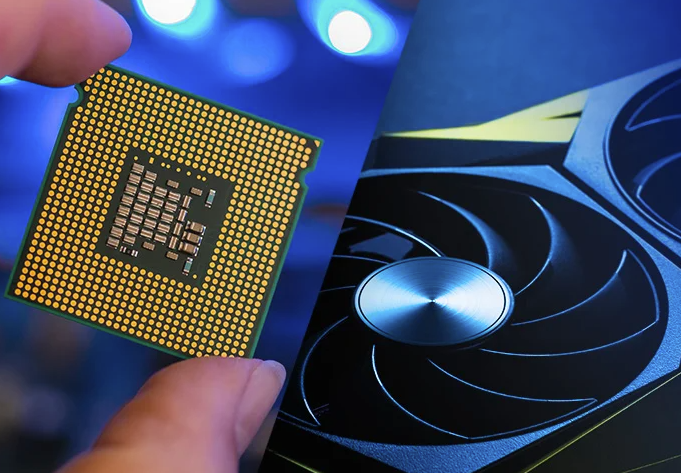
CPUs and GPUs serve different ends: CPUs handle complex control flow with fewer cores, while GPUs execute massive data-parallel tasks using many shader units. Memory bandwidth and thermals shape their effective performance, pushing CPUs toward single-threaded efficiency and GPUs toward throughput. The best choice hinges on task nature—irregular or latency-sensitive work favors CPUs; parallel workloads favor GPUs. When they combine forces, data movement and partitioning become critical, leaving questions about orchestration and scalability open for exploration.
What CPUs vs GPUs Do (and Why It Matters)
CPUs (central processing units) and GPUs (graphics processing units) perform fundamental, but distinct, roles in modern computing. CPUs execute general tasks via CPU cores, coordinating logic and control.
GPUs accelerate parallel workloads with GPU shaders, handling graphics and data-parallel operations. Memory bandwidth governs data movement, shaping efficiency, while thermal throttling limits sustained performance. Understanding these differences clarifies system design and performance expectations.
How Each Architecture Handles Workloads
Hitting the limits of parallelism, GPUs handle large data-parallel workloads by distributing identical operations across many shader units, while CPUs pursue a mix of branches, control flow, and serial tasks across fewer cores. Tasks map to compute units or cores via thread scheduling, kernel launches, and warp scheduling, balancing memory bandwidth, data locality, and instruction level parallelism for CPU throughput and GPU parallelism.
Choosing Between CPU and GPU for Your Task
Making the right choice between a CPU and a GPU hinges on the nature of the task: does it benefit from parallel throughput or from flexibility and single-thread performance?
The decision weighs latency vs throughput, as well as energy efficiency vs performance.
For highly parallel workloads, GPUs excel; for complex control, CPUs offer targeted efficiency and responsive latency.
When They Team Up: CPU-GPU Collaboration Patterns
A practical workflow emerges when CPUs and GPUs operate in tandem, each handling the part of the task best suited to its strengths. Collaboration patterns emphasize data locality and task partitioning: CPUs manage control, orchestration, and irregular work, while GPUs accelerate parallel computation. Fast data access becomes a shared objective, reducing transfers; coordinated pipelines maximize throughput and deliver scalable, freedom-friendly performance.
Frequently Asked Questions
How Does Memory Bandwidth Affect CPU Vs GPU Performance?
Memory bandwidth limits data throughput, favoring GPUs in parallel workloads while CPUs rely more on cache hierarchy to minimize latency; higher bandwidth benefits both, yet GPUs exploit wider buses, whereas cache efficiency sustains CPU instruction pipelines.
Can CPUS Emulate Gpu-Specific Instructions Efficiently?
Emulation feasibility is limited; CPUs cannot efficiently replicate GPU-specific instructions. Instruction emulation incurs overhead, diverging architectures and sparsely supported instructions hinder performance, making practical, high-throughput emulation generally impractical for demanding graphics workloads.
Do GPUS Ever Replace CPUS Entirely for General Tasks?
Yes, GPUs cannot fully replace CPUs for general tasks. Ironically, even gnome clusters and quantum supremacy hype aside, CPUs remain essential for control, logic, and diverse workloads, while GPUs accelerate specific parallel tasks and specialized accelerators.
What Energy Cost Differences Exist Between CPU and GPU Workloads?
Energy cost differences vary; GPUs often deliver higher energy efficiency for parallel workloads, while CPUs may be more energy-efficient for sequential tasks. Consider energy efficiency and hardware cost when balancing performance, throughput, and power budgets for freedom-loving designs.
See also:mytecharmcom
How Do Compiler Optimizations Differ for CPU and GPU Code?
Compiler optimizations differ: CPU code emphasizes vectorization, inlining, and branch prediction; GPU code prioritizes memory coalescing, kernel fusion, and thread-level parallelism. CPU parallelism and GPU scheduling shape performance, power, and portability for freedom-loving developers.
Conclusion
In the end, the decision hinges on the task’s nature. The CPU weighs decisions, handles control flows, and navigates irregularities with measured caution. The GPU surges through data with relentless throughput, marching in parallel. Yet neither dominates alone; their strengths converge only when data and work partition harmoniously. Silence lingers as developers choose partitions, minimize transfers, and fuse insights—knowing that the true payoff arrives when collaboration reveals a performance that neither could achieve solo. The audience waits, watching the outcome unfold.